
Duke renovates historic residence hall
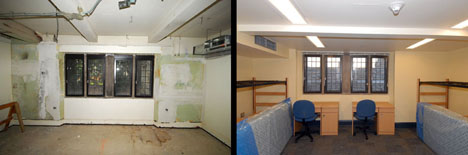
Duke has given a historic landmark a modern day makeover with a tradition-laden feel. The newly renovated Few Quad, which opened to students this week, hadn't had a major remodel since its construction in 1938.
The primary focus of the renovations for the 116,000-square-foot residence hall was to upgrade the interior infrastructure of the brownstone building. That meant adding new sprinkler systems and smoke detectors, increasing electrical wiring to allow for brighter hallways and rooms and gutting and rebuilding bathrooms.
"We get to tie past and future together in the present," said Paul Manning, director of project management with the Facilities Management Department. "We're restoring a building 70 years old and improving it, so 70 more years can be gained from this historic building."
With work starting May 15, the university fit a year's worth of construction into seven months, finishing the $25 million project Dec. 29. Workers put in 10-hour workdays, six days a week. At the end of December, 17,580 hours were logged for the project. At its peak, there were about 250 people working at the Few Quad at the same time. On average, about 170 workers were on site each day during the renovation process.
For students, new additions to the Few Quad don't just mean brighter hallways and new bathrooms. Bedrooms got a new paint job with an off-white color and blue trim around portions of the rooms. The closets in the rooms also received a new feature -- motion detector lights that will turn on and off based on movement in the space. If there's no activity after about 20 seconds, the lights automatically turn themselves off. As with other dorms on campus, wireless internet was also given a boost in the fall to strengthen connection capability.
"The changes offer students an excellent environment while they're at Duke, not only in terms of supporting their learning, but supporting them socially as well," said Joe Gonzalez, associate dean for residential life. "I really feel like we're offering a new and improved environment."
Dudley Willis, the facilities project manager for the renovations, said rewiring the residence hall's electrical circuits was important. In the 1930s, college students weren't using appliances such as computers, microwaves and refrigerators, so the wiring wasn't suited for what Duke students need today. Before renovations, three rooms would share one circuit. Now, there are two circuits for each of the roughly 200 rooms.
Lounges were also upgraded. Instead of having one main lounge on Few's first floor, there are now several lounges throughout the building. In addition to new furniture and kitchen appliances, some of the lounges have been outfitted with flat-screen TVs and games such as air hockey or pool.
"It will help create more interaction between all the students," Gonzalez said. "It's going to create opportunities for there to be fewer barriers for students."
Since there was no emphasis on uniform building standards in the 1930s, Willis said that every room is different, varying by a few inches in the width or height. That made renovations more challenging when Willis and the design team opened up the original architectural drawings.
"The drawings only gave a general idea of where things should be," Willis said. "We'd take out a part of the ceiling and there would be beams there we had no idea about."
Small aspects of the project are still being completed, such as finishing electrical work and opening up new laundry rooms; one last part of the project begins in May when Duke installs a new roof on the building.
Few still has its original Ludowici tiles atop the building to match the 12 other gothic-style buildings on West Campus, but they will be replaced with a new set of the same clay tiles.
To give the roof the same look, the Ludowici company will artificially age the tiles to look 30 years old. The aging process won't affect the strength of the tiles. Instead, the clay will just go through an extra step in the firing process to appear older.
From the beginning of the project, everyone wanted to focus on keeping the tradition alive with the old building, Manning said.
"It's the Duke way," he said. "We're building tomorrow's Duke today."