Home
    • Sections
      • Arts & Humanities
      • Business & Economics
      • Campus & Community
      • Environment & Sustainability
      • Global
      • Health & Medicine
      • Science & Technology
      • Working@Duke
    • More News & Info
      • Athletics
      • Books
      • COVID Response
      • Media & Opinion
      • Research & Innovation
      • Series
  • Trending
  • Watch
Home

Main navigation

    • Sections
      • Arts & Humanities
      • Business & Economics
      • Campus & Community
      • Environment & Sustainability
      • Global
      • Health & Medicine
      • Science & Technology
      • Working@Duke
    • More News & Info
      • Athletics
      • Books
      • COVID Response
      • Media & Opinion
      • Research & Innovation
      • Series
  • Trending
  • Watch

Socials

  • Facebook
  • Instagram
  • X
  • YouTube

Footer

  • Campus Communications
  • Contact Us
  • Accessibility
  • For the Media

Biology

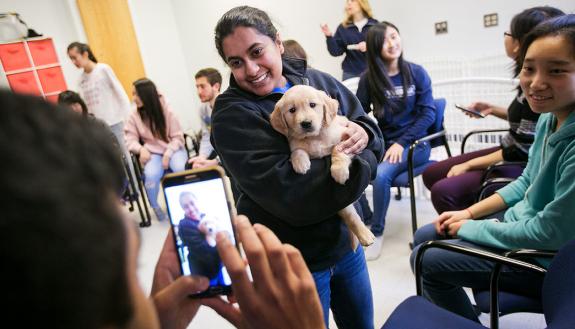
Students helped socialize two 6-week old golden retriever puppies as part of their class. The puppies, MATTOX and CHESSIE, are in training to become assistance dogs through the paws4people foundation. Photo by Megan Mendenhall/Duke Photography

March 21, 2017

Spring Breakthrough: A Week of Learning for Learning's Sake

Read

First spotted in the U.S. in the early 1980s, a sexually confused fruit fly called Drosophila subobscura may have contributed to a collapse in native fruit flies through misdirected mating attempts. Photo by Malcolm Storey, www.bioimages.org.uk.

March 15, 2017

Mating Mix-Up With Wrong Fly Lowers Libido for Mr. Right

Read

A pilot program will place scientists in state government as policy analysts. (Jayron 32 via Wikimedia Commons)

February 22, 2017

Biology Students Launching Science Fellowship Program

Read

February 13, 2017

Mismatched Eyes Help Squid Survive Ocean’s Twilight Zone

Read

Biology grad student Leslie Slota showing Durham 8th graders some fun science.

February 3, 2017

Young Duke Scientists, Making the Rounds to Durham Science Classes

Read on Duke Research Blog

DGHI Affiliate Contributes to Development of WHO Dengue Guidelines

February 2, 2017

DGHI Affiliate Contributes to Development of WHO Dengue Guidelines

Read on Duke Global Health Institute
Female striped plateau lizards from Arizona develop orange patches on their throats when they are ready to mate. Males prefer females with darker spots, a signal that they have higher-quality eggs. Photo credit: Stacey Weiss, University of Puget Sound

January 30, 2017

Model Shows Female Beauty Isn’t Just Sex Appeal

Read

Some baboon males are prone to commit domestic violence when forced to move into a group with few fertile females, researchers find. Photo by Catherine Markham, Stony Brook University.

January 18, 2017

Why Baboon Males Resort to Domestic Violence

Read

The foot of a horsefly is equipped with menacing claws and Velcro-like hairs that help them hang onto fur. Photo by Valerie Tornini.

January 12, 2017

Seeing Nano: Pictures Taken With Electron Microscopes

Read on

Grendel, a 6-1/2-year-old aye-aye at the Duke Lemur Center, is slowly recovering from a near-death experience on Oct. 25 that has been attributed to a natural toxin found in avocados. Photo by David Haring

December 15, 2016

Avocados Blamed For Sudden Deaths Of Four Aye-Ayes

Read

The green glowing center of this Arabidopsis root contains a protein that helps transform immature precursor cells into some of the specialized cells that make up the plant’s root tip. Photo by Erin Sparks, Duke University.

December 6, 2016

Transforming Plant Cells from Generalists to Specialists

Read

A study in rhesus monkeys shows the link between status and health has deep biological roots. Photo by Lauren Brent, University of Exeter

November 24, 2016

Upward Mobility Boosts Immunity in Monkeys

Read

Despite big gains in life expectancy males still lag behind females, and not just in humans but across the primate family tree. Photo by Hapal/Flickr/CC

November 21, 2016

As Life Expectancy Grows, Men Still Lagging

Read

Tyrone Hayes

November 20, 2016

Biologist Uses Media, Rhyme to Resist Pressure over His Findings

Read on

The dragonfish and many other midwater predators have light-producing organs to shine on and detect prey. But the crustacean Cystisoma, at right, grows an antireflective brush structure on its legs that diffuses light, enabling it to hide in plain sight.

November 3, 2016

Midwater Ocean Creatures Use Nanotech Camouflage

Read

November 1, 2016

David Sherwood Named to Lead Embryology Course at MBL

Read

  • Load More
Home

Socials

  • Facebook
  • Instagram
  • X
  • YouTube

Footer

  • Campus Communications
  • Contact Us
  • Accessibility
  • For the Media

Duke Today is produced jointly by University Communications and Marketing and the Office of Communication Services (OCS). Articles are produced by staff and faculty across the university and health system to comprise a one-stop-shop for news from around Duke. Melissa Kaye of University Communications and Marketing is the editor of the 'News' edition. Leanora Minai of OCS is the editor of the 'Working@Duke' edition. We welcome your comments and suggestions!

© Copyright 2026 Duke University. All rights reserved.