
Find Your Wellness Blueprint Before Diabetes Finds You
For Diabetes Awareness Month, Duke’s employee wellness team invites staff and faculty to join the new ‘Balance Blueprint’ program launching in January to help prevent Type 2 diabetes

“It takes more strength than dealing with something acutely that you’re going to recover from, that you can move on from and let go,” she said.
The Centers for Disease Control and Prevention says 1 in 3 adults in the United States have prediabetes, but 81% aren’t aware of it, a notable statistic during Diabetes Awareness Month in November. Research shows that making structured lifestyle changes to improve fitness and nutrition can reduce the risk by 58% of developing Type 2 diabetes, which increases risks for heart disease, stroke, kidney disease and nerve damage.
To help support Duke staff and faculty who are prediabetic, LIVE FOR LIFE, Duke’s employee wellness program, is launching “Balance Blueprint” in January 2026, a 24-week virtual program. Participants with a recent A1C measuring between 5.7 and 6.4 will have group and one-on-one meetings to encourage healthy nutrition, exercise and stress management through education, group support and accountability. Interested employees can sign up here.
“As a person who has worked in health promotion and disease prevention for a long time, I am very aware that knowing what to do to manage your health is the easy part,” said Esther Granville, Health Program Manager for LIVE FOR LIFE. “Much more difficult is actually making lifestyle changes that are effective and sustainable over the long-term. That’s why programs like Balance Blueprint are so helpful for people facing an increased risk for Type 2 diabetes.”
Specific, finite, achievable goals
McCrackin, 62, has a strong family history of Type 2 diabetes that she knows makes her more susceptible to developing the disease. But she has two weighty incentives for wanting to remain healthy and free from long-term medication or limitations of the full-blown disease: 20 years ago, she donated a kidney to a non-family member, and she wants to ensure her remaining kidney is kept untaxed; and eight years ago, she adopted a 6-month-old boy, A.J.
“It’s clear how important it is for his life to have both his parents for a solid, supportive family environment,” she said. “So now there’s actually pressure to try to live a long time because young kids need you to be actively present and participating in their lives.”

McCrackin began working with a LIVE FOR LIFE health coach in August who has helped her prioritize her health and identify “specific, finite, achievable goals.”
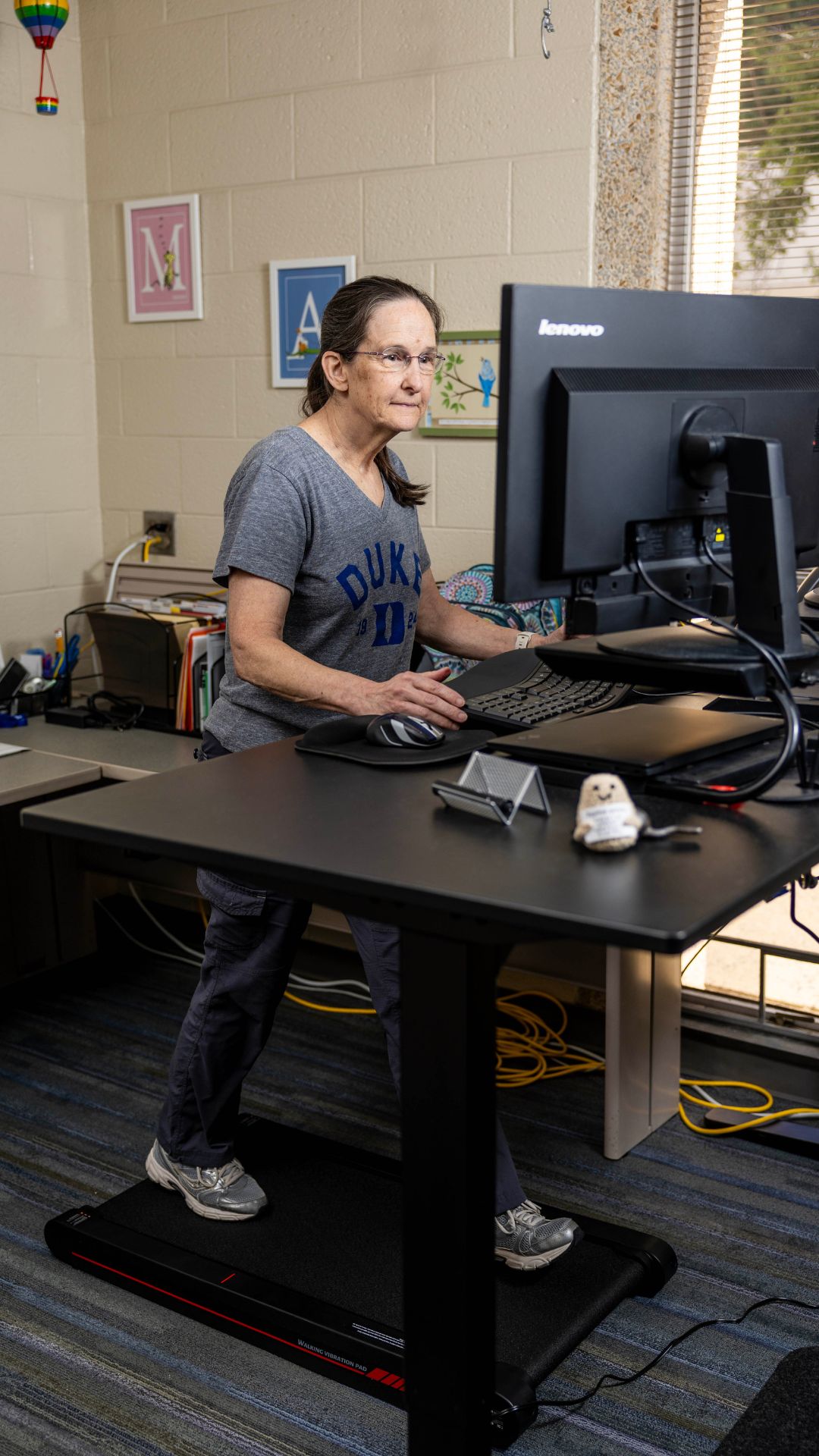
Recently, McCrackin has worked on limiting her son’s screen time before bed to improve sleep for both of them, eating more whole foods rather than processed ones, and finding more time for movement. She packs healthy lunches and now uses a walking pad under her standing desk to log extra steps in the office.
McCrackin calls her LIVE FOR LIFE health coach Lisa Martin her “accountability partner” who helps her stay on course and refrain from feeling overwhelmed or unsuccessful.
“You can kind of inch along and start doing better – sometimes, in spite of yourself and without actually seeing it in the beginning,” McCrackin said. “By the time you’re six weeks in, you can look back and say, ‘Wow, I have made progress.’ And you can celebrate those little wins.”
Diabetes’ effect on your body
When Justin Hoag was in his 20s, he’d often get headaches and feel “woozy” or off-balance. He was regularly fatigued. He attributed it all to stress.
Then Hoag, a Communications Specialist for Duke LifeFlight, had his blood-sugar level tested, and learned he was prediabetic.
Suddenly, all the symptoms made sense.

“There’s just so many things that diabetes does to your body that I don’t think people are aware of,” he said.
With prediabetes, the body becomes insulin resistant, said Granville, the LIVE FOR LIFE Health Manager, and that can be exacerbated by factors such as excess body fat, physical inactivity and sleep disturbances.
“When left unchecked, a person will likely progress into diabetes over a period of years when the body eventually stops producing the insulin needed to control blood sugar,” Granville said.
Hoag, 37, has focused on improving his food choices and exercising to keep Type 2 diabetes at bay, but it’s difficult – especially when he works the overnight shift and sometimes reaches for unhealthy snacks.
“The hardest thing for me living in the South is sweet tea,” he said. “Pretty much anything you really like, growing up in the South is a staple your whole life. It’s really hard to change what you’ve been doing for 25, 30 years of your life.”
But Hoag’s efforts have paid off, keeping his blood sugar in check. He said it’s reassuring to know Duke has resources to lean on for support.
“Duke is really committed to keeping their team healthy as best they can and giving them the resources to do that,” he said.
Small triumphs, McCrackin said, are easier to see with more understanding and support.
“It’s the awareness of trying to make better choices, even if the choices you’re making are better only 30% of the time,” she said. “That’s more than what you were doing before.”
Send story ideas, shout-outs and photographs through our story idea form or write working@duke.edu.
Follow Working@Duke on X (Twitter), Facebook and Instagram and subscribe on YouTube.