
Colleagues and Friends Remember Historian Raymond Gavins at Service

Historian Raymond Gavins was remembered for excelling as a scholar, teacher, mentor and friend during his more than four decades in the Duke Department of History during a memorial service on Saturday.
Dozens of colleagues, students and friends gathered in Duke’s Lilly Library on East Campus to remember Gavins, who died this past May.
“I don’t think any of us knows another person as gentle as Ray,” said William Chafe, a Duke historian who worked with Gavins for 45 years. “Although he had much to be angry about in his life and in our society, he approached every interaction with colleagues and students with a gentleness that immediately conveyed a sense of confidence in who you were, and a sense of optimism that together, we would find a way to the right answer.”
Gavins was a pioneer: In 1970, he became the first African-American to receive a Ph.D. from the University of Virginia Graduate School of Arts and Sciences. He also was the first African-American to join the Duke history faculty.
A veteran of the Civil Rights Movement, Gavins helped developed Duke’s Oral History program, most particularly the Behind The Veil project, which conducted more than 1,350 oral history interviews with African Americans from across the South. The recordings remain an important resource for documenting African-American life during the Jim Crow era.
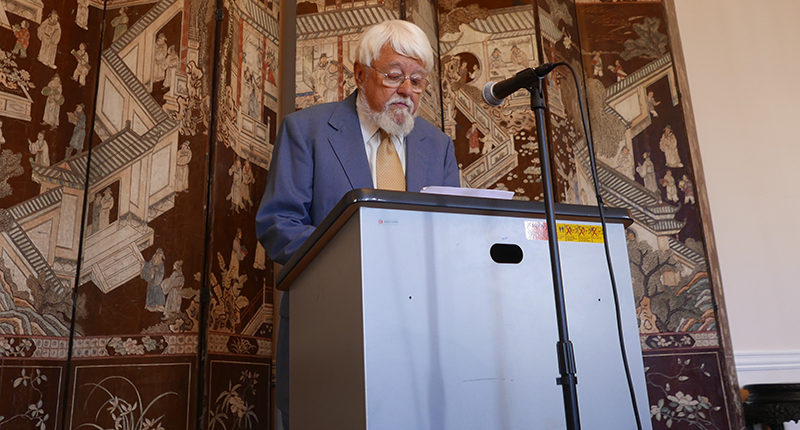
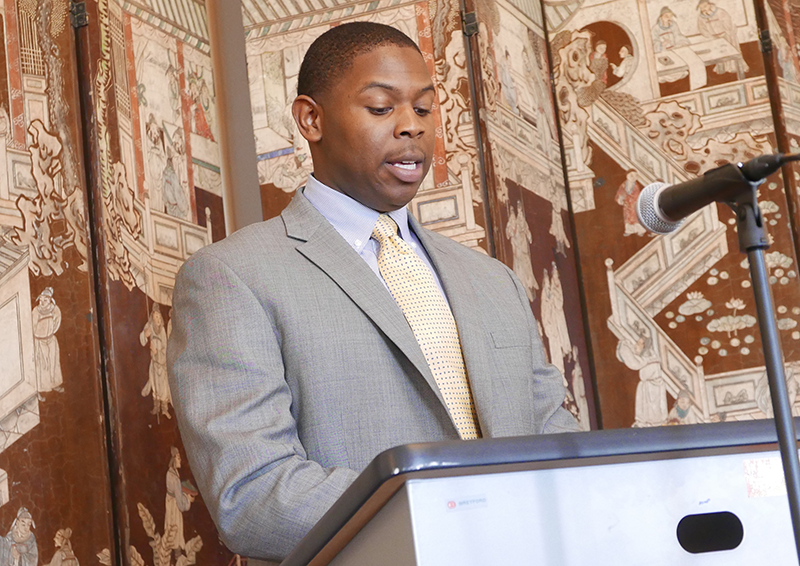
Above, Chafe talks about Ray Gavins. Bottom, current Duke law student Marcus Benning discusses Gavins' important role as a mentor. Photos by Carson Holloway.
Speaking Saturday, Chafe said that work has helped “transform the way historians have understood and written about the Civil Rights Movement.”
“Over those four decades, our team enrolled more than 40 graduate students who came to Duke to use oral history to better understand the grass roots activism that produced the Civil Rights Movement,” Chafe said. “Half of those students were black, and more than half of the 40 published their dissertations as books. Even better, more than half of those books won national history prizes.”
A number of current and former students were on hand to discuss Gavins’ leading role as a mentor to young scholars, not just at Duke but across the country.