
Playgrounds For All
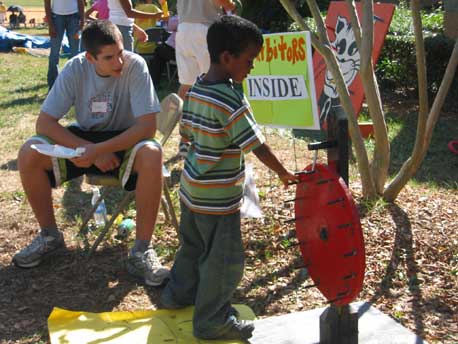
Ripal Shah learned about the transformative power of community involvement while she was still an undergraduate at Duke. Through a chance conversation with the mother of a child in a wheelchair, Shah realized that playgrounds are not welcoming areas to kids with disabilities, who may grow up never experiencing what it's like to swing, slide or ride a merry-go-round.
"When people think about the disability population, they more often think of educational and workplace equality, but there's no reason why recreational equality should not also be addressed," Shah, '06, says.
Although she was unsure whether she would be taken seriously, Shah went to local officials and asked whether Durham might build a playground that is fully accessible to children with disabilities.
"It was good timing," recalls Sarah Hogan, recreational manager at Durham Parks and Recreation.
Just over a year later, with the help of physical therapists, parents, kids, Duke student engineers and Durham firemen, Shah's vision of an accessible playground at 1100 Morreene Road became a reality. The site now features ramps, special chair-back swings, a Braille clock and alphabet and a flat rubber surface that is firm enough to roll a wheelchair on, yet pliant enough to break a fall.
Others on campus and across Durham share Shah's concern about the issue. This Oct. 18, as part of Disability Awareness Month, Hogan will again rely on volunteers from across the community to support Durham's third annual "Unity in the Community Day." The celebration, to be held at the I.R. Holmes Sr. Recreation Center on Alston Ave., will include music, food and vendors offering free services such as wheelchair adjustments and spa treatments. It will also feature a host of recreational sports adapted for children with physical challenges.
Duke junior Parker McKee is one of several members of Duke's men's lacrosse team who volunteered at the event last year, performing tasks such as setting up the music stage, helping out with children's activities, serving food donated by local restaurants and directing traffic flow.
"I remember how much it meant to me when I was younger and had a chance to hang out with older athletes, so that was one of the reasons I decided to participate," McKee says.
Members of UNC-Chapel Hill's rugby teams have pledged their participation this year, as well as the Riverside High School wrestling team and other local high school students.
You don't have to be an athlete to help out says Ashley Thomas, an adaptive sports coordinator with the nonprofit organization Bridge2Sports.
"We have to have the leg people, literally," says Thomas. "The fact is, we can't do what we do unless we have someone helping bring the balls in, setting up the floors. Volunteers with bodies that are fully functioning are key."
Thomas, who has spina bifida and uses a wheelchair, says many adults with disabilities are also among the volunteers and skilled athletes, serving as valuable role models.
The games run the gamut from blind baseball or "beepball," to power hockey and basketball (using electric wheelchairs), to hand cycling, skeet shooting and sit volleyball. New to the lineup this year: kayaking and bocce ball, an Italian version of bowling.
The event seeks to encourage healthy interaction between people with, and those without disabilities. Most important, says Thomas, it allows children with physical challenges to learn about the many options available to them for recreation, fitness and self-empowerment.
Sam Miglarese of the Duke-Durham Neighborhood Partnership and director of community engagement at Duke looks forward to Duke students continuing to work with Durham Parks and Recreation in raising awareness of disability issues.
"Morreene Park has been a shining example of Duke student involvement with the city," he says. "I didn't initiate it; the students did. I love to see this special population acknowledged and supported by Duke student volunteers."
"We're looking for ways the university can be more transformative in the community, and a lot of that can be done through the volunteer efforts and the engagement of students," adds Phail Wynn, vice president for Durham and regional affairs at Duke.
"Getting them to apply their energy and enthusiasm to some of the real-world challenges in the community can help them get a better understanding of the ways they can be transformational in their careers, as well as while they're here at Duke," Wynn says.
Ripal Shah is living up to Wynn's prediction. Even as she applies to medical schools, she is continuing to work with the foundation she created out of her experience, From the Ground Up, Inc., which is awaiting official nonprofit status.
"My goal is to promote recreational equality for children nationwide," Shah says. "If you see an issue in your community and you can do something about it, it doesn't make sense not to."
***
Unity in the Community 11 a.m. to 3 p.m., Saturday, Oct. 18 I.R. Holmes Sr. Recreation Center, 2000 S. Alston Ave., Durham Information: 560-4288 x223