
Cindy Van Dover: Marine Lab Director
Imagine you've never seen a tree before, and you're walking down a country lane at night with only a flashlight to show the way. The light beam plays over the roots of the tree first, then up the trunk and finally into branches that go on and on and on.
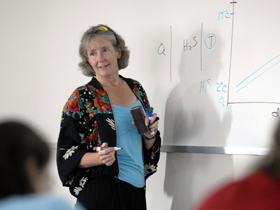
Cindy Lee Van Dover, the new director of Duke's marine laboratory at Beaufort, experiences such discoveries frequently as the headlights of the explorer submersible Alvin pierce the inky waters a mile and a half or more below the sea's surface.
"Part of the discovery is the exercise of your brain piecing together a landscape through only a flashlight view at a time," Van Dover said. An expert in hydrothermal vents and chemosynthetic ecosystems, Van Dover made her first dive in 1985 and is one of the few people in the world who thoroughly knows hot vent sites on the ocean floor.
Additional Readings

Cindy Van Dover interview, Central Indian Ridge expedition, 2001.
Fulbright stories: Cindy Van Dover in France, 2005.
Hornbach MJ, Ruppel C, Saffer DM, Van Dover CL, Fulton PM, Holbrook WS (2005) Coupled geophysical constraints on heat flow and fluid flux at a salt diapir. Geophysical Research Letters 32:L24617.
Beatty JT, Overmann J, Lince MT, Manske AK, Lang AS, Blankenship RE, Van Dover CL, Martinson TA, Plumley, GF (2005) An obligately photosynthetic bacterial anaerobe from a deep-sea hydrothermal vent. Proceedings of the National Academy of Science 102: 9306-9310.
"I dive so much I have to remind myself I'm not in a place I'm supposed to be, a human being on the bottom of the sea," she said. "You can look at pictures all you want and never know what it is really like. We get to go places where there have never been pictures. You dive some places where nobody's ever been."
Named director in August, Van Dover aims to lead the Marine Lab –- part of the Nicholas School of the Environment and Earth Sciences -- to world-class status in marine and conservation science and policy. The school recently opened an Ocean Science Teaching Center and has plans to add a molecular biology facility. The faculty is developing creative field trips for small groups of students to accompany a faculty expert to study marine life in Trinidad, Bermuda, Hawaii, Panama and elsewhere.
"The best way to learn is to be in the field looking at animals in their natural habitat," she said.
Van Dover grew up near the New Jersey shore. Daily trips exploring the beach in the summer with her mother and brothers piqued her curiosity about the little animals in the tide pools.
"I always thought invertebrates were odd," she said. "I wanted to know why a horseshoe crab eats with its knees, why shrimp have eyes on stalks, why crabs have five pairs of legs instead of one. Then I started thinking about deep water and that real, true sea monsters might exist. I wanted to get to know what was down there."
She did her undergraduate studies at Rutgers University (from which she later received a distinguished alumna award), obtained a master's degree in ecology from UCLA, then completed her doctoral work at MIT's Woods Hole Oceanographic Institution. A Fulbright Scholarship took her to the Brittany coast in France. Among her numerous professional recognitions is a hard-to-come-by Outstanding Teaching Award from the College of William & Mary, where she taught before coming to Duke.
William H. Schlesinger, dean of the Nicholas School, welcomes her expertise.
"She's a world-class oceanographer," Schlesinger said. "She'll bring a new dimension to research at the marine lab. I'm very excited to have her on board."
A firm believer in experiential learning, Van Dover allows her students access to the large collection of invertebrates she has brought up from the ocean floor. She brings in her dive videotapes to show the environments that cause the adaptations in animals living deep underwater. And students who want to accompany her to field stations on weekends are welcome. Van Dover involves students in research, from conceiving and designing a project to learning photography, histology skills and writing a publishable paper.
As the marine lab director, Van Dover plans to continue the interdisciplinary approach that works so well throughout Duke, she said.
"We're already on the trajectory of building the marine sciences and conservation science, and we want to keep going," she said. "We have to find the edge and make sure we're on it."