
Maybe it's a hazy memory of a joyous summer childhood day at the beach or of that adventurous first day in kindergarten, but most of us can conjure fleeting recollections of our earliest childhood. But when we try to take ourselves back to our earliest days, before around age four, we all suffer "amnesia." Psychologist Patricia Bauer wants to find out why.
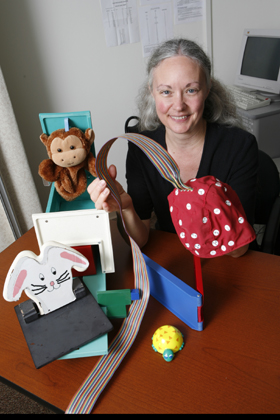
The new professor in the Department of Psychological and Brain Sciences uses ordinary toys, high-tech brain monitoring and ingenuity to explore the memory capabilities of infants. Her experiments aim not only to satisfy that itch of scientific curiosity about the origin of an ability central to our lives, they also aim to understand how traumatic memories might be detoxified.
"For those of us who study memory, it is the foundation of all cognition," Bauer said. "You cannot think about concepts or planning or problem-solving unless you have memories. But since it's a very foundational concept, many people think it's simple, perhaps no more than a mental tape recorder. But we know that that simply, absolutely is not true. Memory is a very complex, reconstructive process."
Bauer, who comes to Duke from the University of Minnesota, will continue her experiments as a participant in two of the department's major research themes. She joins colleagues who explore childhood cognitive development as well as the "Memory at Duke" (MAD) group that concentrates on the intricacies of memory processes.
Basically, her behavioral experiments involve showing a child objects (for example, nesting cups and a block), as well as a distinctive activity with the objects (for example, putting the block inside the cups to make a rattle). She then analyzes how the child remembers the activity over time. She also uses a neural measurement called "event-related potentials," which require only fitting a comfortable cap containing recording electrodes over the child's head. This technique enables her to measure children's brain signals to detect when objects spark a neural memory response.
Bauer's activities also extend to writing, and her book on memory, Remembering the Times of Our Lives: Memory in Infancy and Beyond (Lawrence ErlbaumAssociates) is due out next year.
Many researchers had long believed that childhood amnesia stemmed from the developmental immaturity of neural memory structures, Bauer said. However, studies have revealed that by age six months infants are already forming memories. Bauer said her experiments are exploring how other pieces of the neural puzzle contribute to memory development.
"One important component of what we call autobiographical memory is personal involvement, so the child has to have developed a concept of 'self' This means an understanding that 'self' today is the same as yesterday and will be the same tomorrow. Other concepts are time and place, so memories can be put into context," she said. The immaturity of these abilities in children may be among the causes of childhood amnesia, she said.
"Although we know that by as early as nine months the rudiments of this memory system are in place, it's very fragile," she said. "I think of retaining memory as like walking a balance beam. We adults have mature cognitive capabilities that make us like an Olympic gymnast, able to recover when nudged. But a nine-month old, without all these capabilities, will lose memories -- like falling off the beam -- with even the slightest disruption."
Thus, her studies reveal, the "forgetting" process may contribute much more to childhood amnesia than the ability to form memories. Bauer's research also has educational implications, indicating that storytelling in the home may help foster broader memory skills.
"We find that children whose parents tell them stories, showing that they value narrative, and also who tell stories themselves do better on deliberate memory tasks, presumably because that same kind of rehearsal, thinking about the past and valuing memory, spills over into this strategic domain as well," she said.
What's more, autobiographical memory skills may be an important social tool.
"Think about when you were starting school for the first time," she said. "To get to know your peers, one of the first things you do is tell stories about your experiences. So a question we're asking is whether children who have good autobiographical memory skills are also more socially competent, better liked by their peers and have a better sense of their own self-competence in peer relations."
Also, such memory studies may ultimately help treat post-traumatic stress disorder (PTSD) and depression. The studies could lead to techniques to help people suffering from PTSD to "reframe" bad memories to be more positive.
The studies also could yield insight into the interplay between depression and memory, since depressed people invariably conjure memories whose negativity seems to track the severity of their depression.