Home
    • Sections
      • Arts & Humanities
      • Business & Economics
      • Campus & Community
      • Environment & Sustainability
      • Global
      • Health & Medicine
      • Science & Technology
      • Working@Duke
    • More News & Info
      • Athletics
      • Books
      • COVID Response
      • Media & Opinion
      • Research & Innovation
      • Series
  • Trending
  • Watch
Home

Main navigation

    • Sections
      • Arts & Humanities
      • Business & Economics
      • Campus & Community
      • Environment & Sustainability
      • Global
      • Health & Medicine
      • Science & Technology
      • Working@Duke
    • More News & Info
      • Athletics
      • Books
      • COVID Response
      • Media & Opinion
      • Research & Innovation
      • Series
  • Trending
  • Watch

Socials

  • Facebook
  • Instagram
  • X
  • YouTube

Footer

  • Campus Communications
  • Contact Us
  • Accessibility
  • For the Media

Biology

The Aedes aegypti mosquito, which can spread dengue fever, Zika virus and yellow fever. New research shows mosquitoes are able to “sniff out” trace amounts of insecticides using specialized receptors on their antennae. Photo by James Gathany, CDC

May 11, 2021

How One of the Oldest Natural Insecticides Keeps Mosquitoes Away

Read

Tiny and transparent mantis shrimp larvae provide insights into the mechanisms behind ultra-fast movements. Researchers can see muscles contract to slightly deform the exoskeleton and lock the arm in striking position. (Jacob Harrison)

April 29, 2021

Baby Mantis Shrimp Don’t Pull Their Punches

Read

A grazing Coquerel's Sifaka contemplates the next tasty leaf in the Duke Lemur Center's natural habitat enclosure. (Lydia Greene)

April 23, 2021

Flexible Diet May Help Leaf-Eating Lemurs Resist Deforestation

Read

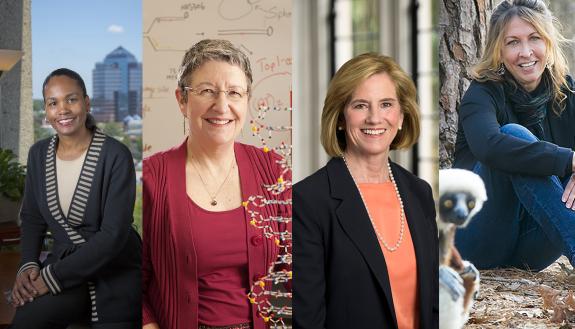
Duke's new members of the American Academy of Arts & Sciences (L-R) Boulware, Jinks-Robertson, Klotman, Yoder.

April 22, 2021

Dean and Three Senior Faculty Elected to American Academy of Arts and Sciences

Read

As warming oceans drive fish into cooler, deeper waters, the colors they rely on for survival could become harder to see. A mere 20-meter drop in the water column turns this fire goby from magnificent to muted. Credit: Nazir Amin.

April 21, 2021

Warming Seas Might Also Look Less Colorful to Some Fish. Here’s Why it Matters.

Read

White outline of the state of North Carolina on a dark blue background.

April 16, 2021

Duke in North Carolina: Deep-Rooted Ties in Communities Across the State

Read

Graphic of human brain with computer parts.

April 12, 2021

Artificial Intelligence Research at Duke

Read

Inland-creeping saltwater is changing U.S. coastal wetlands, and now you can see the effects from space. Credit: NASA / U.S. Geological Survey

April 5, 2021

Mapping North Carolina’s Ghost Forests From 430 Miles Up

Read

Microsoft Outlook screens.

March 10, 2021

How to Get More Out of Your Outlook Email

Read

WaSH-AID team member Molly Matlock conducting wastewater sampling. Photo: Duke Center for WaSH-AID

March 4, 2021

Comparing the Swab to the Sewer

Read on Pratt School of Engineering

February 19, 2021

Time-Lapse Reveals the Hidden Dance of Roots

Read

We are 99% the same as Chimpanzees at the genetic level, but the differences of that one percent are dramatic. (Photo by Petr Kratochvil)

February 18, 2021

Learning From Our Closest Relatives

Read

Just the size of a sunflower seed, the amphipod Dulichiella wields a giant claw that snaps shut 10,000 times faster than the blink of a human eye. (Tomonari Kaji)

February 8, 2021

Tiny Crustacean Redefines Ultra-Fast Movement

Read

Steven Heritage holds one of the rediscovered Somali Sengis in the field in Djibouti.

February 3, 2021

In Djibouti, Lemur Center Researchers Lived a Tale of "Discovery" and Loss Seeking an African Mammal

Read on Duke Magazine

Clare Engstrom

January 8, 2021

Student Researcher Works to Treat Duchenne’s Muscular Dystrophy

Read on Duke Research Blog

2020 Schwartzman Scholar Yuexuan Chen

December 7, 2020

Duke Senior Named a Schwarzman Scholar, Will Study in Beijing

Read

  • Load More
Home

Socials

  • Facebook
  • Instagram
  • X
  • YouTube

Footer

  • Campus Communications
  • Contact Us
  • Accessibility
  • For the Media

Duke Today is produced jointly by University Communications and Marketing and the Office of Communication Services (OCS). Articles are produced by staff and faculty across the university and health system to comprise a one-stop-shop for news from around Duke. Melissa Kaye of University Communications and Marketing is the editor of the 'News' edition. Leanora Minai of OCS is the editor of the 'Working@Duke' edition. We welcome your comments and suggestions!

© Copyright 2026 Duke University. All rights reserved.