Home
    • Sections
      • Arts & Humanities
      • Business & Economics
      • Campus & Community
      • Environment & Sustainability
      • Global
      • Health & Medicine
      • Science & Technology
      • Working@Duke
    • More News & Info
      • Athletics
      • Books
      • COVID Response
      • Media & Opinion
      • Research & Innovation
      • Series
  • Trending
  • Watch
Home

Main navigation

    • Sections
      • Arts & Humanities
      • Business & Economics
      • Campus & Community
      • Environment & Sustainability
      • Global
      • Health & Medicine
      • Science & Technology
      • Working@Duke
    • More News & Info
      • Athletics
      • Books
      • COVID Response
      • Media & Opinion
      • Research & Innovation
      • Series
  • Trending
  • Watch

Socials

  • Facebook
  • Instagram
  • X
  • YouTube

Footer

  • Campus Communications
  • Contact Us
  • Accessibility
  • For the Media

Biology

Protein molecules move within a stable scaffolding in the sheet-like mesh that surrounds and supports most animal tissues. By A. Kawska.

July 7, 2020

Glowing Worms Provide Live-Action Movies of the Body’s Internal Scaffolding

Read

Some fish shine lights in their own eyes for better disguise. Image courtesy of Alex Davis and Duke SMIF.

June 11, 2020

Lights in the Eyes for Better Disguise

Read

Duke students Anmol Warman ’22 and Pranav Warman ’20 have trained a computer to spot the telltale signs of COVID-19 in lung scans and rule out other infections that look similar to the human eye.

May 31, 2020

Duke Students Taught a Computer to Detect COVID-19 in Lung Scans

Read

May 22, 2020

How a Male Fly Knows When to Make a Move on a Mate

Read

The malaria parasites growing inside this infected red blood cell (blue) will eventually burst out in unison with millions of other parasites lurking in red blood cells around them. This feat of timing is coordinated by the parasite’s internal clock. NIH.

May 14, 2020

Malaria Parasite Ticks to its Own Internal Clock

Read

A collage of four photos.

May 11, 2020

Embracing Something New During Uncertain Times

Read

New members of the AAAS: Clockwise from top left: Rachel Kranton, Fan Wang, Richard Mooney, Vincent Price, Sally Kornbluth, Joseph Heitman, Blanche Capel and Geri Dawson.

April 23, 2020

Price, Kornbluth and Six Senior Faculty Join American Academy of Arts & Sciences

Read

2020 Bass Fellows : (from left to right) Sheila Patek, Jun Yang, Brenton Hoffman, Gregory Samanez-Larkin​​​​​​​ and Christine Payne

April 23, 2020

Five New Bass Professors Named for Excellence in Teaching and Research

Read

Duke undergraduate Laura Naslund ’19 and colleagues have found high levels of selenium in aquatic insects and the spiders that feed on them downstream from a major coal mining site in southern West Virginia. Photo by Jacqueline Gerson, Duke University

April 6, 2020

Stream Pollution From Mountaintop Mining Doesn’t Stay Put in the Water

Read

Some butterflies have ultra-black wings that rival the blackest materials made by humans, using wing scales that are only a fraction as thick. Duke researchers have figured out how they make ultra-thin substances that soak up all the light.

March 10, 2020

To Make Ultra-Black Materials That Won’t Weigh Things Down, Consider the Butterfly

Read

Binbin Li

March 10, 2020

The Wild Work of Tracking Giant Pandas

Read on Duke Kunshan University

An image taken of the adult gonad structure of a C. elegans worm in the Sherwood Lab,

March 6, 2020

Squirmy Science: A New Way of Studying Biology

Read on Duke Research Blog

California gray whales like these mothers and calves are 4.3 times more likely to strand themselves during a burst of cosmic radio static from a solar flare, further evidence that they navigate by Earth’s magnetic field. (Image: Nicholas Metheny NOAA)

February 24, 2020

Solar Storms Could Scramble Whales' Navigational Sense

Read

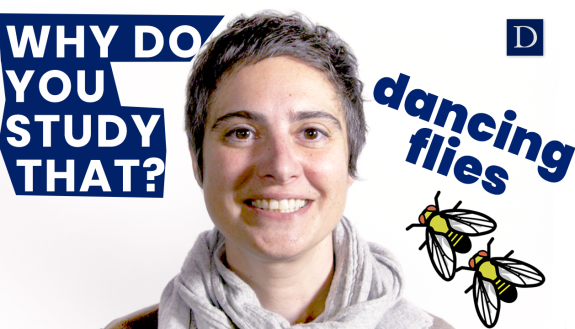
Pelin Volkan studies dancing flies

February 5, 2020

Why Do You Study That? Dancing Flies

Read

Diagram of cancer evolution

January 28, 2020

The Evolution of a Tumor

Read on Duke Research Blog

Alexandra DiGiacomo ’20 writes about her research examining how drone-based remote sensing methods can help assess habitat health along the North Carolina coast

January 28, 2020

Summer in the Salt Marshes: Bass Connections on the Health of Coastal Habitats

Read on Bass Connections

  • Load More
Home

Socials

  • Facebook
  • Instagram
  • X
  • YouTube

Footer

  • Campus Communications
  • Contact Us
  • Accessibility
  • For the Media

Duke Today is produced jointly by University Communications and Marketing and the Office of Communication Services (OCS). Articles are produced by staff and faculty across the university and health system to comprise a one-stop-shop for news from around Duke. Melissa Kaye of University Communications and Marketing is the editor of the 'News' edition. Leanora Minai of OCS is the editor of the 'Working@Duke' edition. We welcome your comments and suggestions!

© Copyright 2026 Duke University. All rights reserved.