

Remembering the Civil Rights Movement
An photo exhibit at Duke Libraries featured iconic and unsung images by civil rights movement photographer Danny Lyon
Lyon became a member of the Student Nonviolent Coordinating Committee (SNCC), pronounced “Snick,” and its first staff photographer. He was hired by James Forman, SNCC’s executive director, who he described as “the least recognized of the great civil rights leaders.”
A chronicle through photographs
His work with SNCC chronicled some of the Civil Rights Movement’s most iconic and unsung figures and moments. Two years ago, the Rubenstein Library acquired Lyon’s SNCC photographs and papers. An exhibit of his work, “Movement and Memory,” was on display at the library’s photography gallery. The exhibit, which opened in April and closed in November, was an apt reminder of the Civil Rights Movement and the leadership of Martin Luther King during the federal holiday that honors his legacy at the helm of the Southern Christian Leadership Conference.
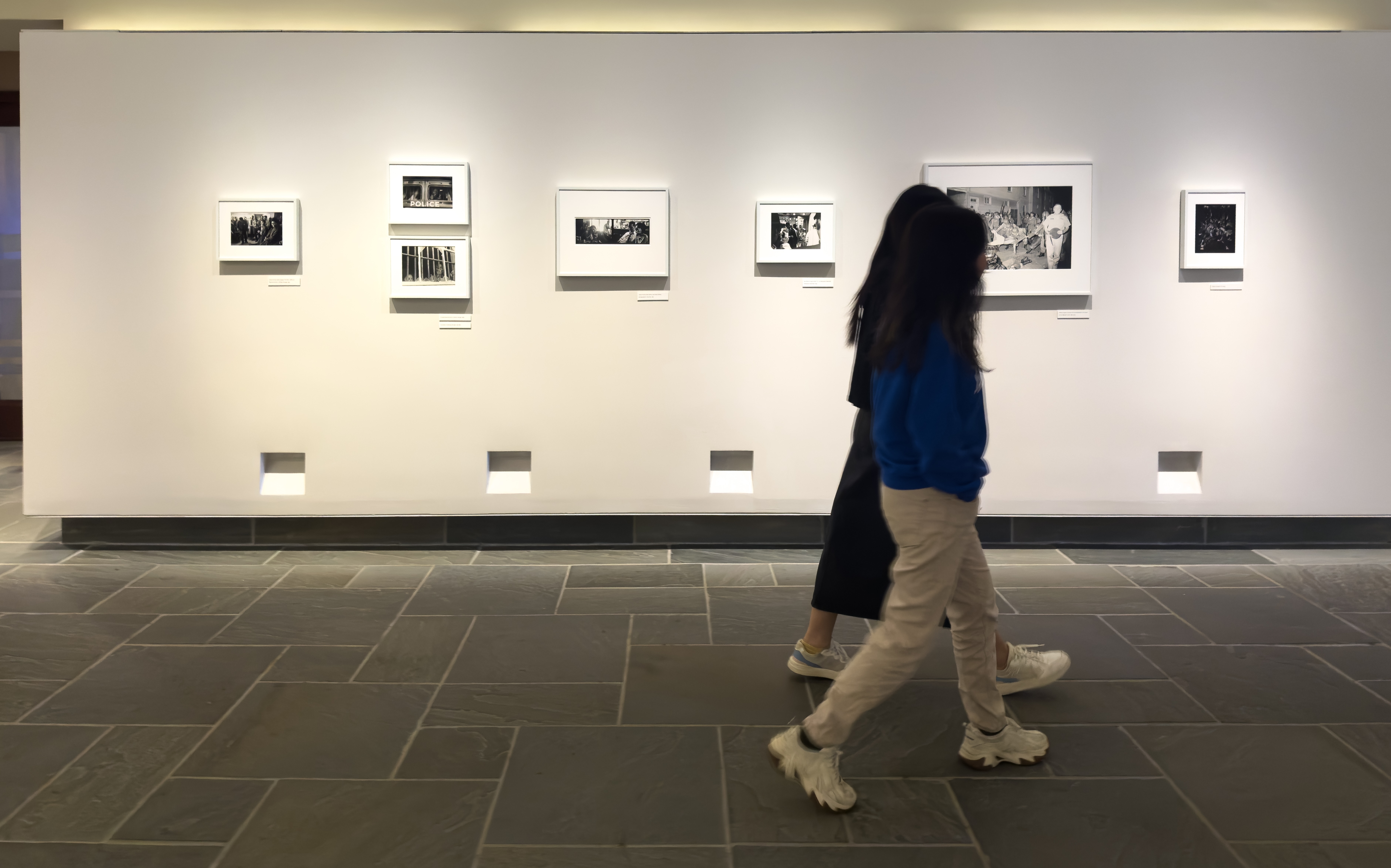
The exhibit, managed by Caitlin Margaret Kelly, curator of the archive of documentary arts at the university’s David M. Rubenstein Rare Books & Manuscript Library, features an observation by retired politician, civil rights giant and former U.S. Ambassador to the United Nations Andrew Young: “(the) SNCC utilized photographers with a focus on the function of their work, yet, ‘Danny took this function and made art.’”
Lyon made pictures of the September 1963 funeral for the four murdered girls in Birmingham, Alabama.
“Everyone was furious of course,” he said about the victims who died when the church they attended was bombed during Sunday School. “And SNCC people expected, and probably hoped for some kind of disruption, some mass protests. It really didn’t happen. Just a lot of sadness and heartbreak.”
Lyon captured enduring images of the 1963 March on Washington, including a picture of Lewis speaking at the Lincoln Memorial before civil rights martyr Martin Luther King delivered his “I Have A Dream Speech.”
Lyon’s 50-years-long friendship with Lewis ended with a deathbed interview.
“I was lucky to know him,” he said. “I’m humbled.”
A trajectory
A native of Queens, N.Y., Lyon was born in 1942, when Roosevelt was president. He described Queens as “a homogenous and boring place” and he yearned to see the rest of America.
Lyon credits his father — a physician and immigrant from Nazi Germany — an “excellent photographer and filmmaker” and Civil War photographer, Mathew Brady, “the historian with a camera,” as influences.
“When the (Civil Rights) Movement began, I understood that a great historic event was taking place, an event that had its roots in the Civil War and slavery,” he said. “I was the campus photographer and a history major. I grabbed two cameras and went south. It was fateful, and one of the best decisions I ever made.”

The first place Lyon traveled to was Albany, Georgia, during the height of the Albany Movement in 1962. King was jailed there. Lyon was locked up too in a segregated jail.
“I was in jail a day and a night and was bored out of mind,” he said. “I couldn’t wait to get out.”
Lyon said it was important to honor the movement’s unsung heroes.
“This was a grassroots movement of young Southern Blacks, often high school students. It is the model we all need to overturn injustice in America,” he said. “It involved thousands and thousands of people across the Deep South. SNCC provided organizing, discipline and leadership.”
Lyon thinks the country will survive the current political climate marked by intense racial enmities not see since the Civil Rights Movement, saying America is “too vast, too great, too beautiful a country.
“America,” he said, “has always struggled against its internal hates and racism.”
“Memories of the Civil Rights Movement,” featuring Danny Lyon’s photographs and history of SNCC can be found at Bleakbeauty.com, or on Instagram at Dannylyonphotos2.