
How Duke Helps Students With Wellness From Day 1
Absence of structure can impact new students’ lives. These resources focus on integrating good health practices.

“One of the things we know about many students is when they first get to college, the first things that go out the door are wellness behaviors,” Skiles said. “They sleep less, their diet is often less balanced. For students coming out of high school who have been in a highly regimented living environment where everything is mapped out for them, the absence of that structure can really impact their lives.
“So how do we help them start reflecting, even before they get here, about what those pieces look like and help them understand that setting aside time to engage in wellbeing actually improves their ability to do extraordinary things?”
Duke is not alone in this concern. At a moment when mental health experts are raising concerns about wellness issues for the cohort of young adults who came through the pandemic, universities across the nation are devoting more resources to integrate good health practices into student life.
QuadEx: a living-learning model
What is distinctive about Duke’s effort is how wellness work is linked to academic life through QuadEx, the three-year-old living-learning model and how students are involved as peer wellness mentors.
The QuadEx model draws in the entire university community, involving staff, dining services, academic advisers and faculty to integrate wellness discussions and practices wherever students are. Significantly, it also empowers students to develop student-led wellness program born of their own creativity.
QuadEx is still a work in progress seeking to find its identity with students, but Skiles says QuadEx already gives Duke an ability to integrate different wellness efforts across the university that other institutions can’t as easily do.
“Without QuadEx, we would still be doing many of the same programming, but with QuadEx there’s a different foundation,” she said. “QuadEx was developed with a focus around wellbeing and belonging that’s at the core of all its work.
“It’s happening for our residential students: QuadEx transforms their experience and their connection to Duke and to one another. It gives us a different starting point on wellness than if we just had Student Health working in assigned spaces with Academic and Residential Life all working in their different spaces.”
Ben Adams, senior associate dean of students for QuadEx, said the effort is often mistaken for just being a residential model. In fact, it is a university-wide commitment to building student engagement across campus life, from academics to wellness.
“You can’t have vibrancy and well-being without a strong residential structure,” Adams said. “But it’s also how we partner with the identity centers, and with the Wellness Center and related programs, and how we integrate all of these things so that the student experience is a transformative one.”
“You can’t have vibrancy and well-being without a strong residential structure.”
Ben Adams, Senior Associate Dean of Students
Wellness programming on campus begins with the experiential orientation before classes, where first-year students start building their networks within the class but also making connections with upper class mentors, some of which will continue for years.
While August is filled with programming to help first-year students start strong, Adams said QuadEx is designed to keep wellness at the forefront throughout students’ time at Duke.
When the honeymoon period is over
One point of emphasis is the sophomore year, where Adams notes students “lose the honeymoon period of your freshman year.” Early in sophomore year is a significant risk point for student wellness concerns: Duke’s Sophomore Spark program is designed to ensure a strong transition to the upper classes by helping integrate academic and residential life, building career opportunities and strengthening faculty engagement.
Not all the programming is staff-led. One of the program’s strengths is a large team of student wellness interns who lead mindfulness, activities on a regular basis that are open to all students. The interns are trained and overseen by Adams’ office.
The hope is that rather than build stress over a mid-year paper, the students will take 30 minutes or more out to do activities such as painting, scrapbooking, crocheting, or meditation – anything that brings them enjoyment. Some students lead group health sessions where people share reflective practices and learn from each other’s successes and challenges. Other sessions focus on somatic awareness and good sleep practices.
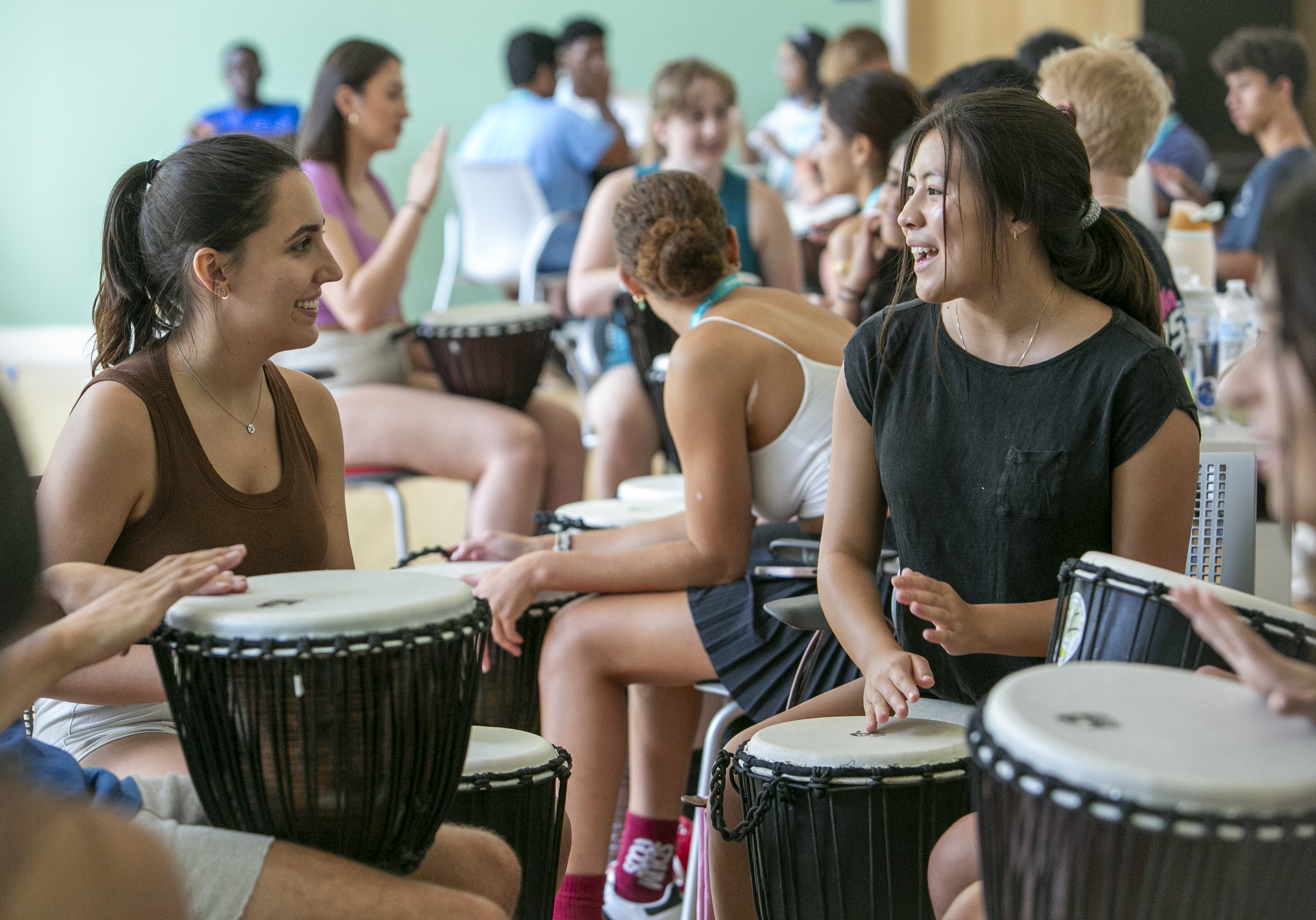
Sarah Holehouse, a wellness intern who graduated in May, said her interest in wellness came from her own experience as a student.
“In high school I realized that I was working too hard than what was sustainable,” she said. “I wasn't sleeping. I didn't have any hobbies because I was always up late doing work for school or my extracurriculars. I realized that it was important to focus on wellness. Once I did, I actually started sleeping better and found more things to do that I enjoy.”
As an intern, Holehouse held wellness sessions on East Campus – the residential home of first-year students. However, she said the sessions also attract a significant number of graduate and professional students who find the East Campus location and nighttime programming convenient.
Holehouse said she believes student interns bring an authenticity and speak a language with their peers that adult wellness experts can’t always match. For the interns, the work can be rewarding beyond helping their fellow students.
Student interns bring authenticity
“I think it keeps me accountable,” Holehouse said. “Sometimes when I'm like ‘I should stay up late to work on this paper,’ I ask myself if that is the advice I would give to someone as a wellness intern. The answer is ‘no!’ The training that I’ve received as an intern has been crucial to my own internal monologue, where it keeps me accountable to set my own wellness goals. I can’t help others if I’m not practicing it myself.”

A second student wellness intern, Comfort Markwei, ran similar sessions on East Campus, including Pomodoro-technique study sessions, where students work intensely on academics for 25 minutes and then take short breaks doing a range of relaxing activities from using Tibetan singing bowls to playing with tactile games.
Both Markwei and Holehouse said they believe student peer mentoring are central to changing student behavior and attitudes. Students are already having conversations about what they call a “busyness” culture, where they feel an obligation to pack their calendars with extracurriculars while succeeding academically. Peers can point those conversations in a wellness direction.
“We have to meet students where they are and address the realities that they face,” Markwei said. “To faculty and staff, with their experience, they understand that grades are not the end all and that you shouldn’t stay up all night and get that paper in. But to students, that is where they are and getting that paper in matters. There are immediate consequences if they don’t.”
Markwei related a conversation she had with Trinity College Dean Gary Bennett about why Perkins Library was closed at midnight.
“He said he knows it’s annoying to students that Perkins closes when they want to study, but he said this was a structural solution to a public health issue,” said Markwei, an A.B. Duke Scholar from Tennessee. “Duke wants to encourage students not to be working 24/7. They close the library to push students to find other study spaces or just to go to bed.
Addressing the busyness culture
“I appreciate that Duke is looking to build student wellness into the structure of the university. Convincing students to take an hour out of their day to go to a moment of mindfulness is difficult, but when you close the library, it forces them to say, ‘if Perkins is closed, maybe I should go to bed or maybe I should do some things to take care of myself.’”
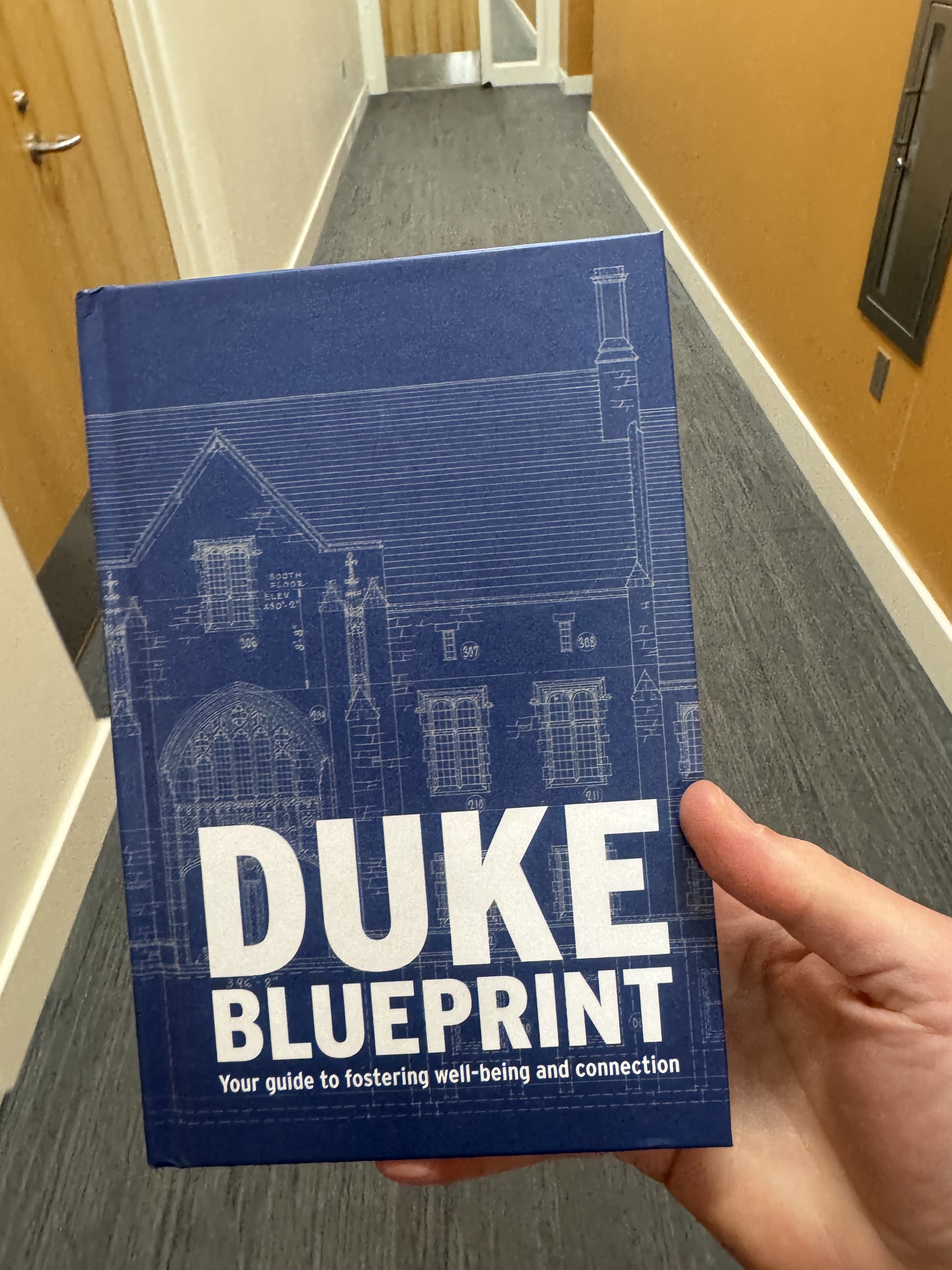
Adams says that as QuadEx further evolves, he is working with students to develop pilot projects to address the busyness culture.
Two of those pilots will launch this fall. The first is the Duke Blueprint. This guide to well-being and connection includes weekly reflections written by upperclassmen describing what they wish they knew first semester freshman year. Each week’s theme is mapped onto common experiences of first year students, such as finding new friends, experiencing imposter syndrome, and a first “C.” It gives students space to journal and reflect while also providing them resources.
The second project is Shmoody, a well-being app that will be made available to all students, staff, and faculty in January 2026. This fall a cohort of undergraduate and graduate students will pilot the app, which offers well-being practices and Duke resources.
“Through these two new projects, we hope we can get students to reflect and narrow their focus a little bit, so that every year it doesn’t feel like that have to be in 20 clubs and burn candles at both ends,” he said. “We want them to slow things down to help them discover the sense of wonder and the sense of awe that a liberal arts education is centered on.”
Skiles said students are interested in exploring culture change, and Duke faculty and staff are focused on helping them.
“We sometimes forget to remind ourselves about what this generation has lived through and how they’ve overcome some of the most extraordinarily challenging circumstances, from COVID to the impacts of social media,” Skiles said. “They are still here, doing incredible things. They are probably the most aware cohort of students that we’ve ever worked with when it comes to talking about mental health and the importance of wellbeing and self-care.
“So, I’m very, very optimistic.”