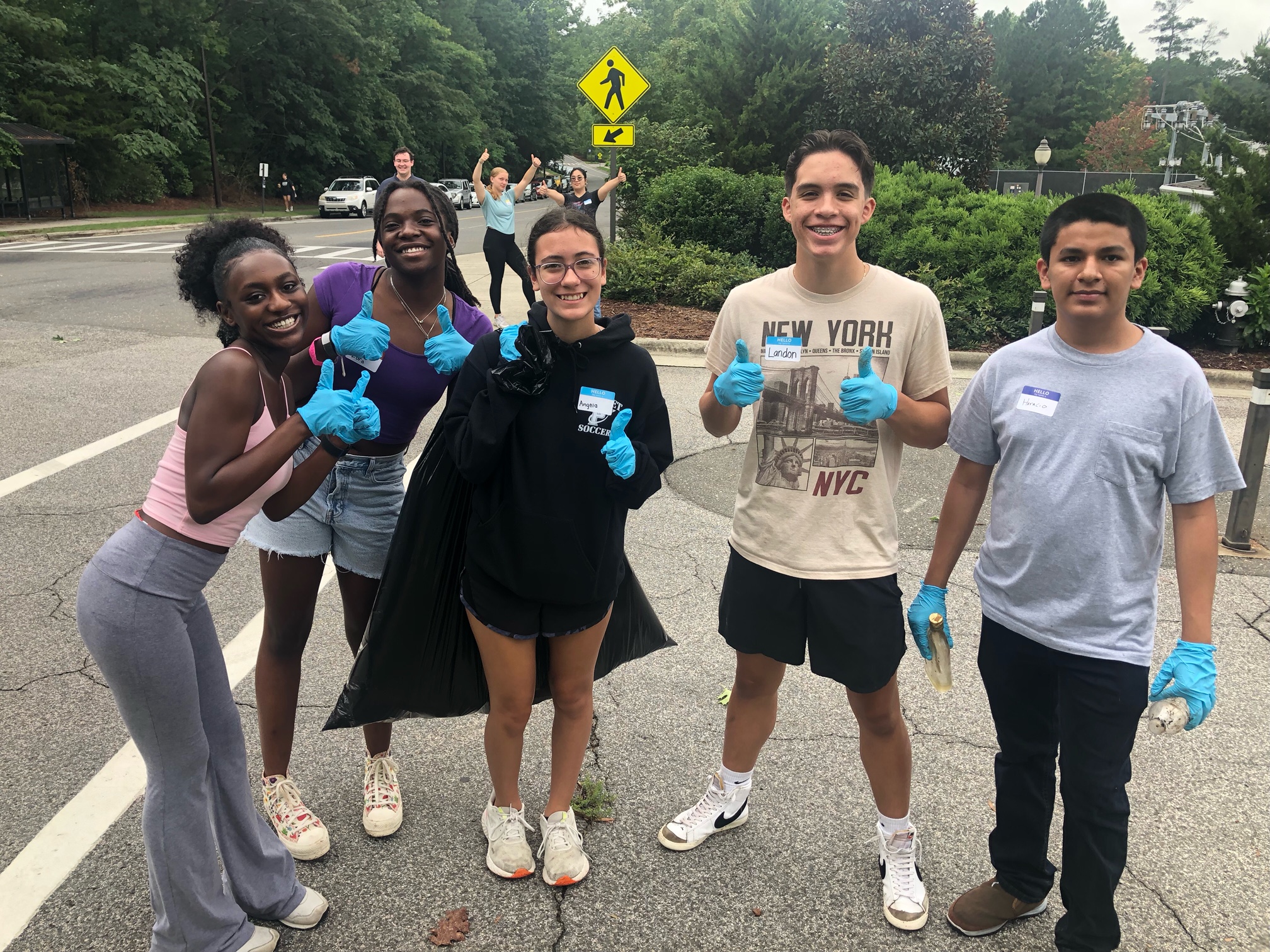
Local high schoolers work together at Duke on research projects related to human health & the environment
Image
During their week at Duke, the HackBio group climbed the 239 steps of the Duke Chapel.
In 2019, Jason Somarelli, assistant professor of medicine, along with his wife, Meagan Dunphy-Daly, associate dean in the Nicholas School of the Environment, started a program for high school students who were interested in science careers yet who were from backgrounds traditionally excluded from those fields.
Somarelli had been the first in his family to attend college and found it difficult to navigate. That experience led Somarelli, with Dunphy-Daly, to design HackBio, a program that aims to equip young people with the tools they need to thrive in college and beyond.
Specifically, the students work together on research projects related to human health and the environment. The projects aim to allow the youth to experience the scientific process – problem solving, teamwork, critical thinking and understanding the limitations of research methods.
During a recent HackBio session in July, students from Durham’s North Carolina School of Science and Mathematics participated in activities that included an undergraduate student panel about college life, science communication training, a pollution clean-up competition, and a research project that considered how plastic harms the environment.
The group donned gloves to clean up plastic in the community.
The program culminated with a hackathon-style, problem-solving event in which teams had to pitch a solution to address the plastic pollution crisis to a panel of expert judges. Teams were awarded prizes for their presentation style, ability to answer questions from the judges and to address limitations and alternative approaches, and their depth of scientific knowledge.
Among the solutions proposed this year, teams pitched a sleek plastic bottle refund kiosk, a local program to clean up Eno River tributaries, a start-up company that uses non-plastic food packaging, and a washing machine filter to trap plastic laundry fibers and degrade them using engineered fungi or bacteria.
Courtney-Ann Dennis, a rising senior from Creedmoor, said about the experience, “I’ve done similar programs that introduced me to research, but this is the first time that I was able to do a program focused on the environmental side of things.”
She added: “It makes me think I could do something related to that field.”
Landon Jimenez, a rising senior from Mooresville, said he got a sense of the soft skills he knows will be necessary in college. “I’ve learned a lot about time management,” he said.
Somarelli said he was impressed by the entire group. “They were so engaged and hard-working, and they brought a lot of fun and excitement to every activity.”