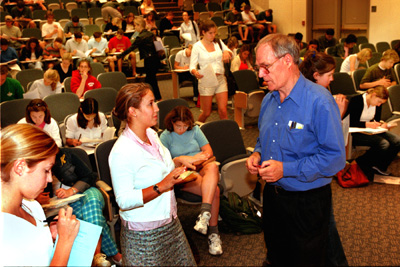
While going through teaching evaluations, English department chair Maureen Quilligan wanted to check out a long-standing assumption: student evaluations of large lecture courses are lower than they are for seminars.
To her surprise, she found in her department that premise didn't hold true.
The main reason? Victor Strandberg, a Duke faculty member for 40 years who until for many years has routinely taught large-enrollment courses in the department.
"If you look closely at Vic Strandberg's huge teaching file, you will see that his evaluations for large lecture classes absolutely and utterly defy the norm," Quilligan wrote in nominating Strandberg for the Robert B. Cox Award. "He manages to get the same - or sometimes even higher - responses to his large lecture classes than he does for his smaller format classes."
The Cox Award is the first teaching award for Strandberg in his time at Duke, and he said it came as a pleasant surprise. He teaches a mix of classes - independent study, seminars on William Faulkner, Robert Penn Warren, T.S. Eliot and others, and several large survey courses on modern American literature.
His rule for enrollment in the survey course is to allow the maximum number of students that he would have time to meet at least once during the semester. That generally comes to around 160. To undergird his personal contact with the many students, he videotapes them for several seconds during their meetings, then studies a class reel including a snippet of each.
He admits that large classes are a potential negative in literature courses, but he said they play an important part in a Duke education. His modern American literature courses covers a wide range of authors, from Ernest Hemingway and Faulkner to Saul Bellow, Carson McCullers, William Carlos Williams, Richard Wright and Toni Morrison.
"I believe that all 6,000 Duke undergraduates - not just a few dozen graduate students or a few hundred English majors - should have a chance to study our national literature," Strandberg said. "Both my observation and experience indicates that they wish by the thousands to do so, especially during their junior and senior years when they realize that their chance to benefit from a broadly liberal education will soon be over.
"Maybe one of the reasons why these courses are popular is that the literature is ageless," he said. "Every generation responds to these works. They find their own different way of responding to them.
|
"The overall theme of my survey course is the search for identity, meaning the struggle to find a satisfactory sense of worth and beliefs to live by. All of these books illuminate this process, whether it is Eliot working through religious values or Richard Wright dealing with race. Young people can relate to that.
"Almost all thoughtful young people have a form of a crisis of belief as they get educated, along with some form of identity problem. In America, you don't inherit a sense of worth through an aristocratic title. We have a need to achieve something and to earn a desirable status among our fellows."
Strandberg stands at the podium for the survey courses, letting the text of the day be the focus. Dozens of times during the class he'll pick out the relevant parts of the text for analysis to underscore the key issues.
"I feel that for every teacher, the central, indispensable instrument of teaching is the teacher's personality," he said. "We all have different personalities, so we are limited in how much we can emulate each other. We have to find what is most effective in our personality for persuading students to examine different views of the subject. In that respect, I suppose I would say my personality is a little theatrical, but not flamboyant."
He enjoys his seminars and independent study courses as well. This semester he's teaching a new course for which he expresses large enthusiasm -- a small seminar on Duke poets, focusing on Reynolds Price, Deborah Pope and James Applewhite.
In seminars, he said, he attempts more innovation than in the surveys. The study of literature has undergone a revolution of methodology since Strandberg started teaching, and he said he'll use all methods - from traditional scholarship focusing on the context and background of a writer and the text to the latest mode of chaos theory. Psychology, religion, history, economics and many other disciplines can be brought in fruitfully.
The first member of his family to attend college, Strandberg never gave teaching much thought until a faculty mentor at Clark University pushed him to do graduate work in English at Brown. He was reluctant at first, saying he had little confidence that he could hold his own in a graduate program, but he took the faculty member's advice and went to Brown.
"I did better than expected and stuck with it. I'm glad I did."
|