As a newly minted professor at the University of Wisconsin, Allen Kelley looked out at his first introductory economics class and immediately spotted trouble.
Staring back at the young professor were 500 students with a wide range of abilities, interests and motivations. How could he possibly know whether his new charges were grasping the material?
Rather than panic, Kelley put his analytical skills to work. What he needed, he realized, was a managerial tool that would allow him to keep tabs on his students, that would pinpoint their areas of weakness and then create individualized lesson plans that would shore up those deficiencies.
This was the early 1970s, and the few computers that resided on campus had not yet made their way into the classroom. Still, Kelley could foresee a computer's utility and, with the help of a grant from the Exxon Foundation, he developed an innovative solution called TIPS (Teaching Information Processing System).
"To get information on how the students were doing, I'd give them a quiz every week," Kelley recalls. "It only took about 15 minutes. Then I'd process those quizzes on the computer. And those questions were divided, usually, into two or three groups around concepts -- demand for something, supply of something, equilibrium.
"I would then look at the students' performance on this and give each student a report. And that report would indicate not just how they did overall, but how they did on each concept. And it would give them an assignment. So if they already knew what demand was, they wouldn't get an assignment on demand. They would get one on supply."
Kelley then instructed his teaching assistants to work with each student on his or her areas of weakness. The result: the failure rate was cut from 15 percent to "almost zero," he says.
Kelley left Wisconsin for Duke a year later and brought his innovative ways with him. In his 30 years in Durham, Kelley has continued to be inventive in how he teaches his classes, whether it's an introductory macroeconomics class with 250 or more students or an intimate upper-level seminar.
Duke economics department chair Marjorie McElroy says Kelley, the winner of this year's Howard Johnson Teaching Award, is able "to engender genuine intellectual excitement and curiosity" in his courses.
Adds Thomas Nechyba, economics' director of undergraduate studies, "It is highly unusual for an instructor to become truly outstanding in either a large lecture setting or a small seminar course. It is almost unheard of for a single instructor to master both environments with such elegance and success as Professor Kelley has in his courses. He has been an inspiration to many of us who strive to be good teachers."
|
To prepare for his larger classes, Kelley rises each morning at 5:30 to scan
The Wall Street Journal, The New York Times, The Economist as well as the local papers. He then posts stories on the Web for his students that touch on economic issues of the day. "I'll say, 'Here's an article that I want you to read and, moreover, here's some questions I want you to be able to answer with respect to that article. Now go out and answer them.'"
Kelley's MacroNews, as the Web posting is known, forces his students to apply the principles learned in class to real-world issues.
"Economics is considered by most people as being dull and boring. That's our rap," says Kelley. "And it's unfortunate that we have this image because, really, economics is incredibly exciting. It's a mindset. If you really know economics, almost everything you think about is seen through a different mindset of organizing things.
"It's not just simply about making money -- if all economists could make a lot of money there would be no economists in academia. My feeling is if I'm going to teach economics well, I've got to hook the students on the applicability and relevance of what we're doing. And for that to happen, they want to find out how is this going to help my life and my personal decisions as well as understanding the world around me."
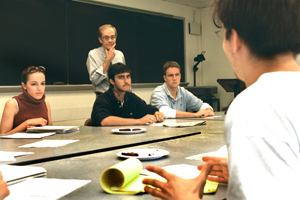
In upper-level seminars, his students often become collaborators on issues that Kelley is researching.
"I think teaching and research can be symbiotic. In my case it's absolutely symbiotic because I happen to be lucky to be teaching in a field which is very close to my research. In one of my seminars that I teach every year, basically we take up seven or eight topics that are directly in the middle of my research.
"So the students take up topics like whether population's good or bad for third world countries. Or are we going to run out of food with the population explosion? Or how much do kids cost and are they worth it? Or how many migrants should the United States accept and what criteria should we place on this? Or should the United State promote family planning to third world countries? These happen to be directly in my research field."
Kelley's students know they're being challenged, and seem to relish it. One student wrote in a course evaluation, "I think I've had to use brain cells I didn't know existed."
Wrote another: "His care for each of his students reaches far beyond the classroom. The passion for his subject is supremely evident in his class. He's concerned with more than our 'numerical grade' but our learning to like what he loves so much. What more could one want."
|